Honey is the sweet liquid produced by bees. They ingest nectar and honeydew, enrich it with substances of their own, store and mature it in honeycombs. Bees produce blossom honeys from nectar and honeydew honey from honeydew. Honeydew is the product of small plant sucking insects. Switzerland produces about 3000 t of honey per year which covers only about 1/3 of its needs, the remaining 2/3 have to be imported. The annual consumption of 1.2 kg honey per capita in Switzerland is one of the highest in the world.
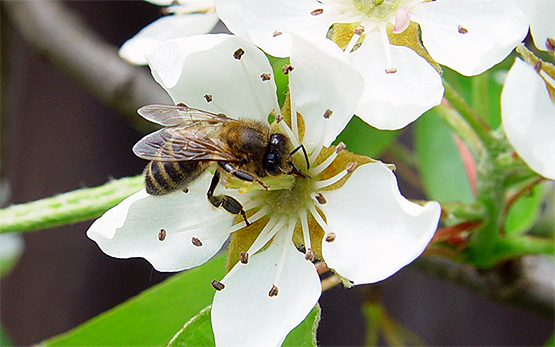
© R. Ritter
Introduction
The way of honey
In this slideshow you can see the main stages of honey production.

The variety of nectar and honeydew influences the honey type. In spring we are harvesting the light colored floral honeys while the harvest in summertime is mainly darker honeydew based honey.
In Switzerland there are few unifloral honeys: rape, sweet chestnut, acacia, dandelion, rhododendron and Abies (fir or spruce). The advantage of marketing unifloral honeys is that consumers can chose honey with a definite odour and taste. Unifloral honey is an added value product. It can be seen as a fingerprint of its area of origin thus telling a story and carrying emotions.
Authentication of Botanical Origin of Honey (PDF, 1 MB, 14.09.2016)
K. Ruoff (2006)
Classification of unifloral honeys with an MS-based electronic nose using different sampling modes: SHS, SPME and INDEX
(The document is available at www.springerlink.com)
S. Ampuero, S. Bogdanov, J.-O. Bosset (2004)
Yeast from feeding sugar patties can be found in honey
A field experiment reproducing a common spring bee feeding practice was performed to understand how sugar paste containing baker’s yeast are introduced into honey. All honeys harvested five weeks after the last feeding contained baker’s yeast, although supers were not placed on the bee hives during the feeding period.
Honey authenticity
The authenticity of honey has two different aspects: Authenticity in respect to honey production and authenticity in respect of descriptions such as geographical and botanical origin.
The food information may only contain approved health claims. Further information on the labelling of honey can be found under Legal basis.
Water Content
Water content is an important quality trait of honey. Ideally, the water content of a honey should be under 17.5%. This enables the beekeeper to sell a high-quality honey that won’t ferment once purchased.
Water-Content Measurements in Swiss Honey of Different Production Years.
Storage and Liquefaction
Honey crystallisation is a natural process. The optimum temperature for honey granulation is between 10 and 18°C. At higher temperatures honey crystallises more slowly. Most honeys stay liquid, if stored in a freezer. There are different methods for honey liquefaction. The most important one is heating, best at 40-45°C. Micro waves are not recommended, because they harm honey by overheating.
In the following documents you can find instructions for honey technology and for the production of natural honey of good quality.
Whoever produces honey and brings it into circulation is a food producer, and is bound by the appropriate consumer protection regulations (health- and fraud protection). ‘Bringing into circulation’ implies any form of passing on, either in return for payment (sale) or free of charge (as a gift).
1. Verordnung über die Primärproduktion (VPrP) (German, French and Italian)
4. Verordnung über den Vollzug der Lebensmittelgesetzgebung (LMVV) (German, French and Italian)
5. Lebensmittel- und Gebrauchsgegenständeverordnung (LGV) (German, French and Italian)
7. Verordnung des EDI über Lebensmittel tierischer Herkunft (VLtH) (German, French and Italian)
An elegant way to fulfil these requirements is to join the Quality Programme of the Swiss Beekeepers Association (Honey Regulations). The Association has drawn up appropriate regulations and directives, and inspects and advises its affiliated members. Beekeepers need not arrange any honey testing themselves, but merely retain reference samples. Sampling and analysis is carried out by the Association. The Honey Regulations contain, in a nutshell, everything that beekeepers need to bear in mind.
Reglement zum Honig-Qualitätssiegel apisuisse (german)
Règlement du miel apisuisse (french)
Naturally, correct labelling is part and parcel of this. An updated factsheet on correct labelling can be downloaded here:
Agroscope
Korrekte Kennzeichnung von Honig.
Zentrum für Bienenforschung. 2025, 2 pp.
other Languages: french | italian
Of course, the legal requirements can also be met without participating in the Industry quality programme. Important here is the exercise of due diligence, and the appropriate documentation of the relevant beekeeping measures: treatments, resources used, honey production and honey quality.
The ‘Mountain and Alpine’ Ordinance governs the use of the terms ‘mountain’ and ‘alpine’ to describe agricultural products, including honey. Mountain and alpine honey sold at points of sale must be certified by a recognised certification authority. Honey which the beekeeper sells direct to the consumer is exempt from compulsory certification.
Kast C., Koller M.
Braucht auch ein als Bergblütenhonig deklarierter Honig eine Zertifizierung, wenn er über eine Verkaufsstelle dem Kunden verkauft wird?
Schweizerische Bienen-Zeitung, 6, 2015, 13.
other Languages: french
Official Inspection
The monitoring of primary production is subject to the cantonal veterinary offices. The enforcement, i.e. the implementation of food law falls within the remit of the cantonal food-inspection authorities, specifically, that of the cantonal chemist. Consumers can send suspicious honey to the responsible cantonal chemist. For quality assessment, the legal requirements – particularly the VLtH (Verordnung des EDI über Lebensmittel tierischer Herkunft) – are consulted.
International
Internationally, the analysis of bee products is coordinated by the International Honey Commission.
Honey Quality, Methods of Analysis and International Regulatory Standards: Review of the Work of the International Honey Commission (PDF, 70 kB, 14.09.2016) (PDF, 70 kB, 14.09.2016)
S. Bogdanov et al. (2000)
International Honey Commission (IHC)
The Codex Alimentarius (international food standards) governs the international standards for honey. Search under ‘honey’ on the website.
Codex Alimentarius, International Food Standards
Further Honey Analysis Methods
Bogdanov S., Bieri K., Gremaud G., Iff D., Känzig A., Seiler K., Stöckli H., Zürcher K.
Bienenprodukte: 23A Honig.
In: Schweizerisches Lebensmittelbuch. Publ. Bundesamt für Gesundheit BAG, Bern (CH). 2003, 1-35.
other Languages: french
Honey consumers expect that honey is a pure and natural product. The contamination of honey, compared to that of other hive products is relatively small. Residue levels depend on the chemicals used by the beekeeper and on the bee hive environment. In order to keep honey pure the use of synthetic and toxic chemicals should be kept to a minimum. The best way to keep honey pure is to perform organic and ecological beehive management.
On the following diagram the sources of beehive contamination are shown.
Chemical Varroa control is the most important contamination source for bee products as these chemical substances are repeatedly used. Only ecologically safe drugs as organic acids and thymol should be used. When applied properly, there are no problematic residues in bee products.
Thymol
Testing for thymol residues in Swiss honey was carried out at the Centre for Bee Research as part of the apisuisse quality seal programme.
Among other things, thymol-containing preparations such as Api Life Var, Thymovar and Apiguard are used to control the Varroa mite. When these products are used according to the manufacturer’s guidelines, only minimal residues occur in the honey, and these do not influence its quality. When such products are used improperly, larger amounts wind up in the honey, negatively affecting its taste.
From a toxicological viewpoint, thymol is relatively unproblematic. Until 2009, a legal tolerance level of 0.8mg/kg honey applied in Switzerland. With harmonisation with EU law, this Swiss tolerance level was abolished. For beekeepers belonging to the quality seal programme, the maximum value of 0.8mg/kg stipulated by apisuisse still applies. In 2013, all ‘quality seal’ honeys met the requirements of the apisuisse quality seal in terms of thymol residues. A honey sample from a beekeeper not belonging to the quality seal programme contained over 0.8mg/kg thymol.
Thymol residues in wax and honey after Apilife VAR treatment (PDF, 757 kB, 14.09.2016)
S. Bogdanov, A. Imdorf, V. Kilchenmann (1998)
Determination of residues in honey after treatments with formic and oxalic acid under field conditions (PDF, 240 kB, 14.09.2016)
S. Bogdanov, J.D. Charrière, A. Imdorf, V. Kilchenmann, P. Fluri (2002)
Amitraz
Products for Varroa treatment containing amitraz as an active substance are not authorised in Switzerland. After application of amitraz-containing products, degradation products of amitraz are detectable in honey and wax. The amounts detected in wax are higher than in honey.
In some countries, antibiotics are used to fight bacterial bee diseases such as American foulbrood. In Switzerland as well as in the European Union, however, the use of antibiotics in beekeeping is not permitted.

Are pyrrolizidine alkaloids (PAs) toxic for bees?
When bees gather nectar and pollen from plants containing PAs, they bring these plant toxins into the hive. Through the consumption of honey and bee bread, adult bees are directly exposed to these PAs. Our experiments showed that adult bees tolerate PAs relatively well. Honey-bee larvae, however, were very sensitive to PAs. Even small amounts of PAs were lethal for the larvae. Even so, we were able to show that only a small fraction of the PAs from the bee bread actually ends up in the royal jelly. Feeding jelly to the sensitive larvae protects them from plant toxins.
Pyrrolizidine Alkaloids (PAs) in Swiss honey
The wide distribution of plants containing PAs means that these undesirable plant substances occur in tea, honey and other foods, and can represent a risk for consumers. Our studies of PAs in Swiss honey showed that this product normally poses very little risk for the consumer. Honey from locations with a high presence of PA-containing plants, especially viper’s bugloss (Echium vulgare) constitutes the exception here. Echium-type PAs are the most common PAs in Swiss honey, and are mainly carried into the honey by the bees via the nectar.
Pyrrolizidine Alkaloids (PAs) in Swiss pollen
We also investigated the contamination of Swiss-produced pollen with PAs. Viper’s bugloss and hemp agrimony (Eupatorium cannabinum) were the main sources of PAs in positive pollen samples. Beekeepers are therefore advised to avoid especially large areas of viper’s bugloss plants in the vicinity of the hives. By ending pollen collection at the beginning of July, beekeepers can avoid hemp agrimony-type alkaloids.