
Yellow nutsedge belongs to the sedge family (Cyperaceae) and is distinguished morphologically from grasses (Poaceae) by a nodeless stem that is triangular in cross-section (trigonous).
Stem
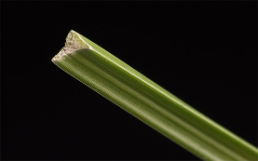
Height 30–70 cm
Nodeless
Triangular cross-section
Leaves
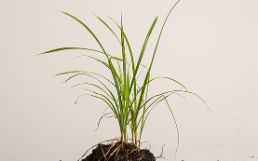
Narrow (5–10 mm) and elongated
Arranged in a ‘V’ shape.
The needles of the leaves feel prickly to the fingertip.
The plant is a yellowish-green in colour.
Flowers
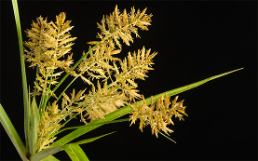
Surmounted by 2 to 9 bracts consisting
of 4 to 10 branches,
bearing yellow or brown spikelets
6 to 12mm in length.
Tuber
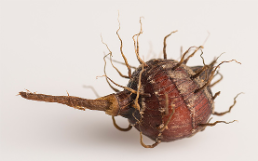
Rounded shape
1mm to 15mm in size
Whole Plant
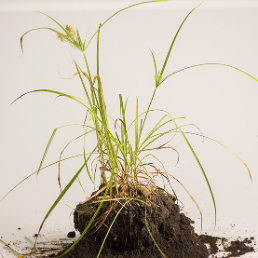
Not to be confused with the hairy sedge (Carex hirta) – which has hairs on the surface of its leaves and puts out stolons rather than rhizomes – nor with several other native sedges (www.infoflora.ch).
Vegetative Phase
Germination occurs from April until autumn, as the soil must have warmed sufficiently for the dormant tubers to germinate. During germination of the mother tubers, one or more vertical rhizomes develop. Basal bulbs form on these rhizomes near the soil surface. These basal bulbs then form shoots as well as secondary rhizomes and basal bulbs. A tuber formed the previous year can thus give rise to numerous individual new plants.
Regenerative Phase
During the regenerative phase, the rhizomes differentiate into tubers. Tuber formation begins at the end of May, or earlier for crops under netting/plastic, and carries on all summer, until the first frosts. The plant overwinters in the form of tubers. We have observed that tubers survive at temperatures as low as -10° C at the soil surface. Although most tubers are found in the surface layer of the soil (down to 15cm), some can form at a depth as low as 50cm from the surface, depending on soil type.
The vegetative and regenerative phases occur at the same time.
Flowering
Although tubers constitute the main means of propagation, it has been demonstrated that germination from seed is possible. Flowering takes place during the summer months, from June to September. The seeds can germinate in the field if there is sufficient water available and competition from other weeds is low. Trials have shown that the young seedlings from seed are as difficult to control with herbicides as those from tubers. Moreover, the risk of wind dispersal of the seed is high. Each seed consists of a new genetic combination with potentially new traits, such as e.g. an adaptation to local climatic conditions, better herbicide tolerance or improved competitive strength vis-à-vis native plants. For these reasons it is crucial that yellow nutsedge plants be prevented from flowering, even at the edge of the field.


Yellow nutsedge multiplies almost exclusively via its underground tubers. A tuber sends out a first shoot, followed by numerous secondary shoots. The plant in question is then capable of forming several hundred new tubers per annum. A single tuber can thus give rise to several thousand new plants in a short space of time (2–3 years), and thus suffices to infest an entire plot.
The amount of seed likely to germinate varies from year to year. The seed resembles grass seed (< 1 mm), and disperses easily. This propagation method favours the adaptation of the species to new conditions. As a precautionary measure, a combined control approach prevents nutsedge from flowering. Nevertheless, the main form of propagation remains the passive dispersal of the tubers.

Tubers at different stages of development

Tubers of various shape

Germinating tubers

Passive dispersal
Main dispersal factor for nutsedge Soil residue on agricultural machinery
The tubers range between a pinhead (1mm) and a pea (15mm) in size, and are for the most part present in the top 15cm of the soil. They are easily dispersed by vehicles, machinery, shoes, with contaminated earth, or the harvesting of root crops (e.g. sugar beet, potatoes, celeriac, etc.). This passive dispersal is responsible for the excessive propagation of yellow nutsedge in Switzerland.