
The hornet Vespa velutina is native to Asia, but has invaded a number of countries far afield from its origins. It was introduced into the southwest of France in 2004 or slightly earlier, and more recently spread to the neighbouring countries. Adapting well to the climate of the majority of French regions, it continues its expansion. In Switzerland, the Asian hornet was first detected in 2017 in the Jura. Since 2019, Vespa velutina has also been observed in the cantons of GE, VD and FR. For the moment (Sept. 2023), it has been observed in several cantons in Switzerland and several nests have already been destroyed in the cantons of BE, VD, GE, JU, NE, FR, SO and BL where it can be considered established.
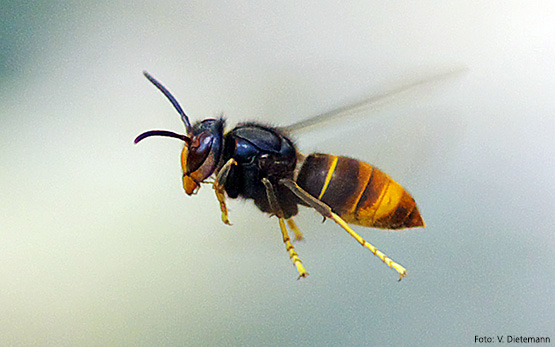

The Asian hornet hunts other insects to satisfy the protein requirement of its larvae. These proteins are found chiefly in the muscles. The hornets therefore dismember their prey, keeping only the thorax, which contains the flight musculature. Adults feed exclusively on the secretions of their own larvae, and once they are done raising the brood, on fruit sap. Hornet colonies grow during the spring and summer months and decline as winter approaches, with only those queens produced towards the end of the season surviving. More information on the Asian hornet can be found in the Bee Health Service fact sheets.

In France, control of the Asian hornet is based on the destruction of the nests that are found and on the trapping of queens or hunting workers when there are large numbers of hornets in front of the hives. Although recommendations are issued concerning what types of traps should be used and during what periods, with a view to minimising damage to the local fauna, this method is not specific enough. In Switzerland, the control strategy is defined by the different cantons. In order to take rapid action, it is important to report suspicious cases as soon as possible via the www.frelonasiatique.ch website, together with a photo or video.