Plant protection products continue to be important in modern plant protection strategies. Their use is indicated where other measures cannot adequately ensure the protection of crops from harmful organisms. We, the ‘Plant Protection Products – Impact and Assessment’ Research Group (RG PPP) investigate the behaviour and impacts of plant protection products (PPPs) in the environment, assess PPP risks and evaluate how alternative plant protection strategies, risk-mitigating measures and new technologies affect PPP input into the environment.
Before a plant protection product may be placed on the market, its benefits and risks are evaluated in an approval procedure. This evaluation is performed by experts at various Swiss Confederation assessment agencies and forms the decision-making basis for the licensing authorities at the Federal Food Safety and Veterinary Office (FSVO).
The Federal Office for Agriculture (FOAG) is the responsible assessment agency for the agricultural aspects. The expert reports are produced by Agroscope, specifically, for the assessment areas of product chemistry, agronomic application and efficacy, formation of residues on plant crops, and risks to non-target organisms (beneficials) and honey bees in the treated agricultural area.
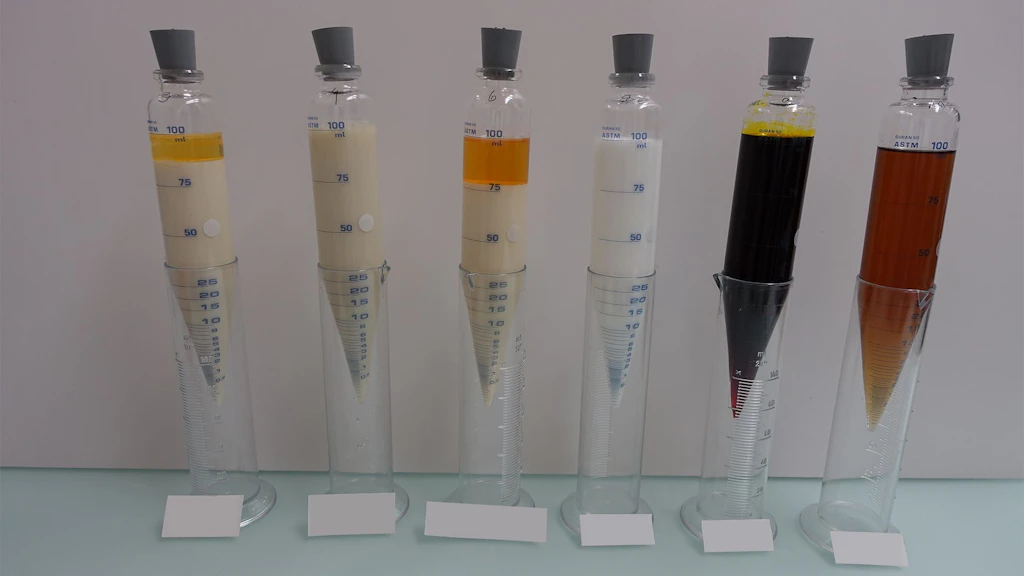
A plant protection product (PPP formulation) consists of one or more active substances, possibly a synergist or a safener, and co-formulants. The co-formulants are what lend the product the properties enabling the active substance to be spread evenly on the field or crop. The requirements for the physico-chemical properties of a product are stipulated in international and European directives. The PPP products must be suitable for use and sufficiently stable during storage. The composition of the product (trade secret), which may not contain any prohibited co-formulants, must be submitted by the company. This information is treated in confidence by the Authority. The identity, physical and chemical properties and impurities from the synthesis of active substances are. The analysis methods, which must be suitable for determining the various analytes, are also evaluated. Each PPP formulation is examined to determine whether the quality requirements are met.
The task of Agroscope’s efficacy experts consists in using the approval dossier to evaluate the suitability and efficacy of PPPs (including living organisms and viruses) to be used in Switzerland to control plant diseases, weeds and pests. This work requires specific knowledge concerning harmful organisms and the quantification of the damage they cause to various crops. In addition to the required efficacy, a PPP must not have any unacceptable effects on the crops or their products. The intended use and application quantity of PPPs and living organisms must be sufficiently optimised for minimal use to achieve maximum effect.
PPP residues on foods must not have any health effects for consumers. In addition, they must not be higher than what is necessary for “good agricultural practice”. Both of these factors are considered for PPP approval. Residue level is substantially influenced by agricultural use. The manner of application, the quantity applied and the time elapsed between application and harvest (the so-called ‘waiting period’) are important factors here. Agroscope experts assess the residues to be expected in plant foods based on residue trials submitted by the companies with their approval dossier. Based on these data, it is checked whether the maximum residue levels (MRLs) valid in Switzerland are being complied with, or new MRLs are derived and their determination requested.
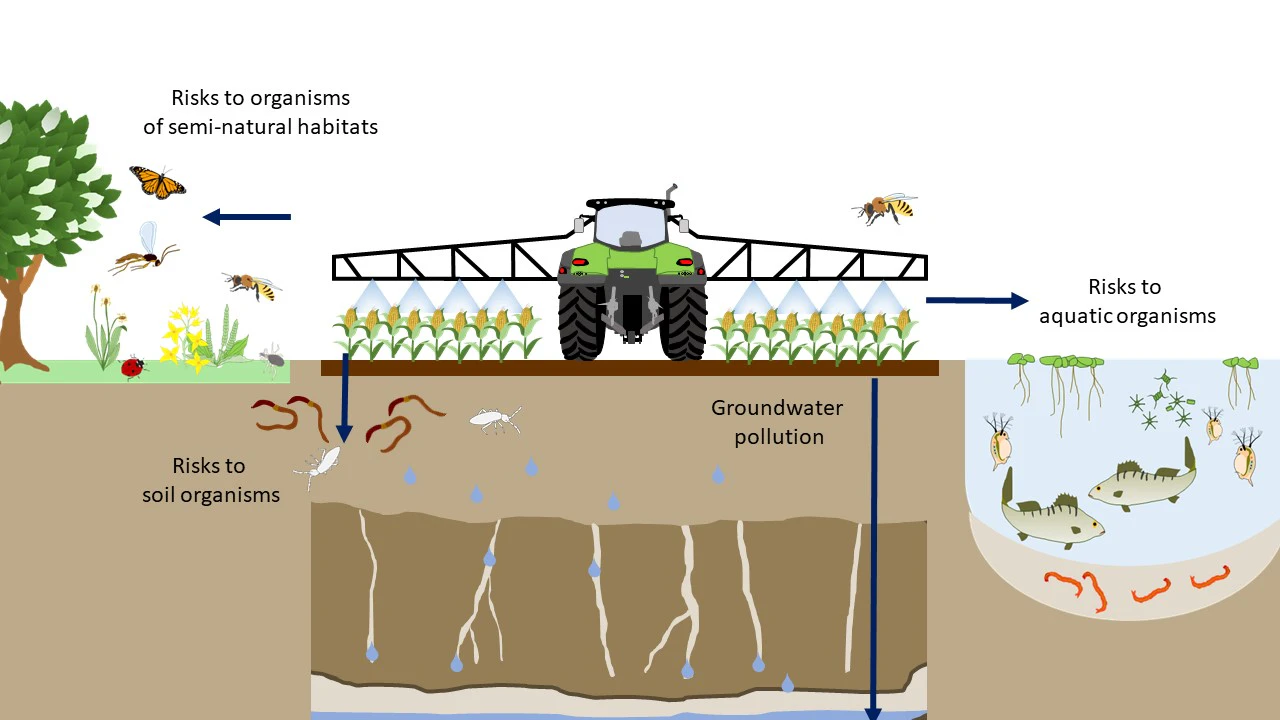
Plant protection products are biologically active substances that control harmful organisms, but which may also have undesirable effects on non-target organisms, and hence on biodiversity in an ecosystem. To gauge the risk of plant protection products, two values are compared: the expected concentration in the various environmental compartments after application of PPP on the field (exposure), and the value for the sensitivity of the respective organisms in the ecosystem (ecotoxicity). The ecotoxicological effects are evaluated by experts at Agroscope based on the studies submitted by the companies. For less risky active substances, toxicity values determined in the laboratory with individual organisms are sufficient (worst-case approach). For higher-risk active substances, more-complex field studies designed to reflect reality more closely must be submitted by the company. This graduated approach is implemented to save on resources and animal testing. The assessment of the risks to beneficial insects and soil organisms in the treated areas is conducted according to guidelines and procedures corresponding to the EU and the EU Member States. The data requirements are specified by the EU.
Some PPPs can pose a risk to bees due to their toxic effects if they are not used properly. In the risk assessment at Agroscope, the aim is to estimate the expected PPP concentration in the treated field and in the bees’ food resources – so-called exposure – and relating this to bee toxicity. The company requesting the assessment submits studies determining bee toxicity in various trials according to prescribed standard tests. In addition, said company can determine information on PPP residues in pollen and nectar. In the case of a suspected possible negative impact, further semi-field and field trials must be conducted. Depending on the experiment, mortality rate, flight intensity, bee behaviour, brood development and colony development are investigated. Since 2019, Switzerland has required studies with bumble bees in addition to honey bees as part of the approval of plant protection products for applications involving novel active substances.
Plant protection products sold in Switzerland must meet various quality requirements so that safety for users, crops and the environment as well as product suitability can be ensured. PPPs sold in Switzerland are inspected annually in a national market control. In our ISO 17025-accredited laboratory the sampled products are examined and test reports drafted for the attention of the Cantonal chemical agencies. The Cantons are responsible for enforcement in the case of identified shortcomings or deviations.
Overview of the projects in the current programme of activities.
Publications Plant Protection Products
You’ll find publications on this topic here.
Further information
Plant Protection Products – Impact and Assessment
The ‘Plant Protection Products – Impact and Assessment’ Research Group combines comprehensive knowledge of plant protection products with expertise on their behaviour and effects in the environment as well as their assessment. The Group’s projects combine experimental research with model approaches and data analysis, thereby contributing to the interdisciplinary consideration of plant protection products in the context of their use in agriculture.



.jpg?rect=0%2C0%2C1920%2C1080&w=1024&auto=format)