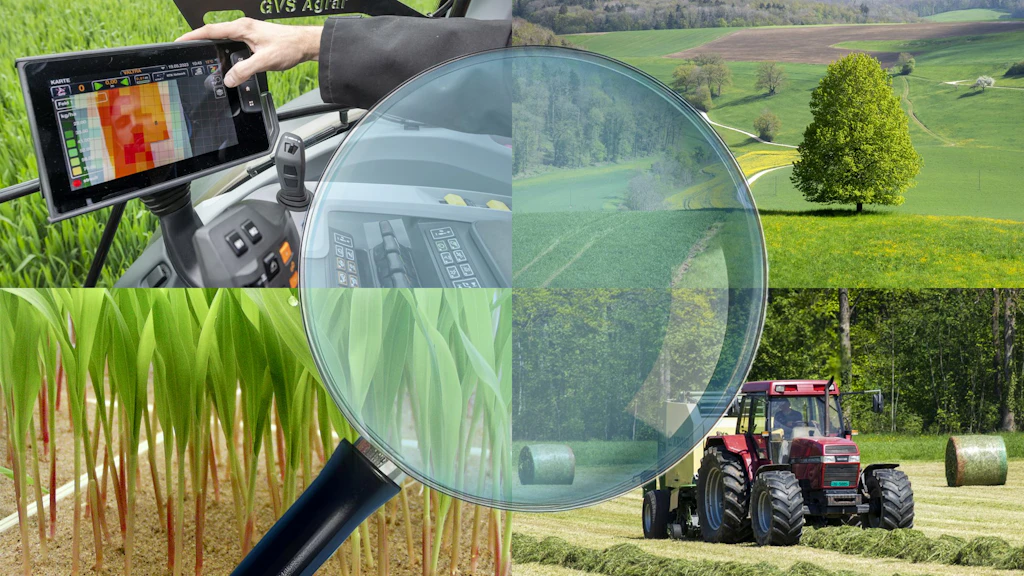
How does agricultural practice affect the environment and how does this environmental impact change over time? Agri-environmental monitoring provides answers.
Agri-Environmental Monitoring (AEM) and the SAEDN – What is It?
In order to develop agricultural policy, it is important to know how agriculture affects the environment. For this reason, the Federal Office for Agriculture (FOAG) performs an agri-environmental monitoring (AEM) service, based on the ‘Ordinance concerning the Evaluation of the Sustainability of Agriculture’ (SR 919.118). Agroscope’s Competence Centre for Agri-Environmental Indicators is responsible for the coordination and calculation of so-called agri-environmental indicators (AEIs), on both a national and individual-farm level.
AEIs are easily understandable, environmentally relevant variables for representing the complex environmental system. For farm-specific statements, the Competence Centre relied on the Swiss Agri-Environmental Data Net-work (SAEDN) from 2009 to 2022, where detailed farm data on stock and practice (e.g. livestock herds, fertilisa-tion practice) were recorded and used to calculate AEIs. Around 300 farms per year had supplied data, with some farms dropping out and new ones joining each year. In 2023, the SAEDN was replaced by the new monitoring of the Swiss agri-environmental system (MAUS); more information on MAUS can be found on. The results from the SAEDN, from MAUS and AEM as a whole serve as a knowledge base for policy decision-makers, as a source of information for the public, and as a basis of comparison with other countries.
Background Information on the Agri-Environmental Indicators
The ecological range of agricultural sustainability is covered by means of several agri-environmental in-dicators from the subject areas of nitrogen, phosphorus, soil, energy, climate, water, and biodiversity/ landscape. The SAEDN considers the indicator types ‘driving forces’ (agricultural practices) and ‘envi-ronmental impacts’ (agricultural processes), whilst the ‘environmental status’ indicators are the responsi-bility of the Federal Office for the Environment.
An example of how AEIs concerning plant-protection products can be assigned to these three indicator types is as follows: the application of plant-protection products on the field, i.e. at what point in time what amount of what active substance is applied, is classed under ‘driving forces’. From this, we can calculate in a subsequent step the amount of plant-protection product that could potentially end up in the water, where it constitutes, as an ‘environmental impact’, a possible risk for aquatic organisms. Lastly, the measurement of the actual contamination of the water with plant-protection products illustrates the ‘envi-ronmental status’. Consequently, the ‘environmental status’ indicators are those most likely to represent the actual environmental pollution, whilst the ‘driving forces’ indicators are those most capable of being directly influenced and controlled.
How Does the SAEDN Work, and Who Are the Stakeholders?
Between 2009 and 2022, data relevant for the SAEDN has been collected from a network of around 300 farms and analysed by Agroscope on an annual basis. The following paragraphs briefly describe how this process worked, and who the involved stakeholders were.
Background Information on Data Acquisition
Farmers collected the necessary data for calculating the indicators in AGRO-TECH, a software program created by AGRIDEA and adapted for the SAEDN. In order to keep acquisition effort as low as possible, it was first and foremost the data already required for the Proof of Ecological Performance (PEP) and by the Ordinance on Veterinary Medicinal Products that had to be collected for the SAEDN.
The direct contacts for the farmers were the so-called ‘AEI experts’, who also actively recruited farmers. Most AEI experts were farm accountancy and fiduciary experts, whose fiduciary services (FS’s) are joined together in the accountancy and fiduciary association treuland. Since 2016, AGRIDEA has also supported data suppliers in this capacity. The AEI experts checked the quality of the data collected from the farmers and passed the data on in anonymised form to the AEI Competence Centre, where the data went through another plausibility check before further processing.
Agroscope’s AEI Competence Centre was responsible inter alia for the coordination of AEI method de-velopment, data management, and the centralised calculation and evaluation of the agri-environmental indicators. Calculation and evaluation occurred in close collaboration with those responsible for the methods. The latter were Agroscope experts who defined and/or supervised the method for calculating the AEIs.
The FOAG financed the SAEDN and published the SAEDN results annually in the Agricultural Report (more under ‘Assessment Levels and Use of SAEDN Data’). In addition, it used these results as an as-sessment tool and decision-making basis for the further development of agricultural policy.
Assessment Levels and Use of SAEDN Data
The SAEDN was based on individual-farm data from a Swiss-wide network of farms. Consequently, it allowed us to make statements concerning the effect of agriculture on the environment at farm level, regional level (plains, hills, mountains) and for 11 farm types (e.g. arable production, suckler cows; according to FAT99 farm typology, cf. FAT 2000). For certain farm types, the excessively small sample size made the acquisition of robust knowledge an impossibility.
The individual AEIs were analysed in depth as key topics in the FOAG Agricultural Report at four-yearly intervals. The timetable for 2021–2024 was as follows:
2021: Biodiversity
2022: Phosphorus & Soil
2023: Energy & Climate
2024: Nitrogen & Water
Where the data flow to
In addition, the results of all indicators have been published in the Table Annexe of the Agricultural Report since 2009. Instead of individual farm data, statistical parameters such as median and mean value are published. These indicators are calculated for all farms as well as for four farm types (arable production, special crops, animal production, combined), which are based on the 11 FAT99 farm types. In addition to a downloadable Excel table, an interactive display format has been available since 2019.
In the so-called ‘individual-farm feedback’ (IFF), participating farmers are provided with the AEIs calculated for their farms, enabling them to compare their farms over the years with all of the participating farms, as well as with the region and the farm type to which they belong.
The AEI Competence Centre is also tasked with the processing and delivery of anonymised data to third parties for further analyses, reports and publications. The procedure and conditions for making such data requests are described at www.agrarmonitoring.ch in the ‘Information for Data Users’ index.
References:
FAT (Swiss Federal Research Station for Agricultural Economics and Engineering), 2000. Neue Methodik für die Zentrale Auswertung von Buchhaltungsdaten an der FAT.
Further information
Are you a farm manager who would like to take part in the SAEDN? Then get in touch directly with your tax consultancy agency, or visit: