
Indicate – Measuring and Optimising Farm Environmental Impacts
The aim of the Agroscope Research Programme Indicate was to develop easily measured indicators for the environmental impacts of farms. The programme ran for four years (2021-2024) and was concluded with a conference and synthesis report.
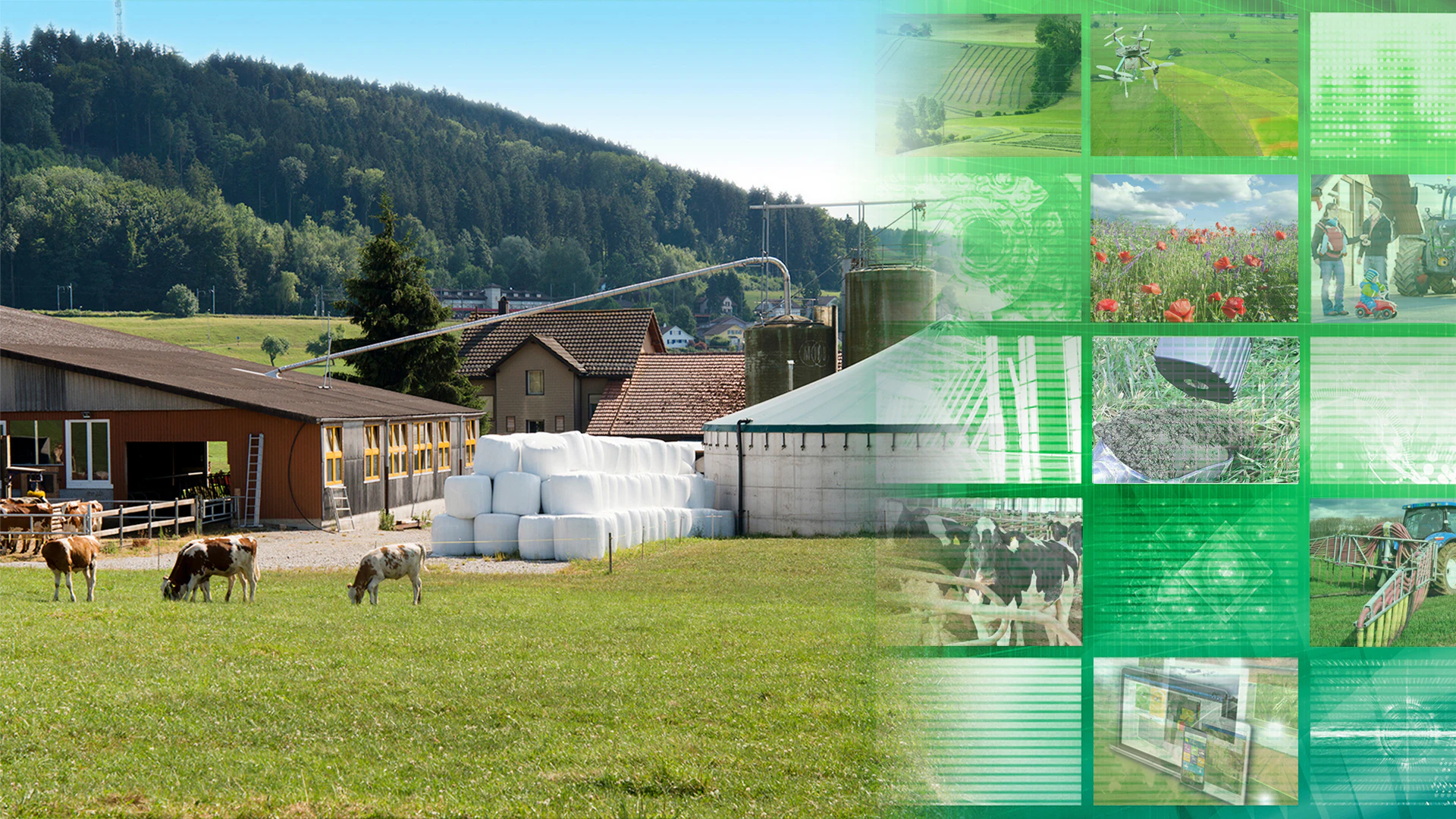
The Agroscope Research Programme Indicate developed indicators for nutrient flows, soil, biodiversity and ecosystem services in grassland and on farmland. Used in conjunction with digital tools, these indicators are meant to support farm management and simplify the reporting requirement e.g. in connection with the Proof of Ecological Performance. In addition, literature on economic and social indicators was analysed in order to gauge the potential for a comprehensive sustainability assessment in Switzerland.
In terms of nutrient flows, fertilisation recommendations were validated, estimation of farm- manure volumes was improved and an indicator for sustainable nitrogen management was generated with the help of Suisse-Bilanz, the enforcement tool for evaluating a balanced farm nutrient budget. In the soil sphere, Indicate developed reference values and a best-practice method for quick and cost-effective recording of soil quality indicators. For biodiversity and ecosystem services, indicators were developed for planning ecological focus areas, making farm land-use decisions and setting target values.
At the same time, it became clear that there is no universally applicable indicator set for the entire Swiss agriculture and food sector. Depending on the level involved – farm, value chain or agricultural policy – goals, data pools and requirements differ in terms of comprehensibility, controllability and enforceability. Because of this, the authors recommend developing indicators in a goal- and context-specific manner and with the involvement of researchers, practitioners, advisors, the public sector and industry.
A further key result concerns data use: Farm Management Information Systems offer major but still largely untapped potential for sustainability assessment and agroenvironmental monitoring. Better dataflows between applications as well as stronger linkage of operational, model-based and spatial data are prerequisites for this.
The programme consisted of nine projects and ran from 2021 to 2024. The results were presented at the Agroscope Sustainability Conference in January 2025. A synthesis report was also published in 2025.