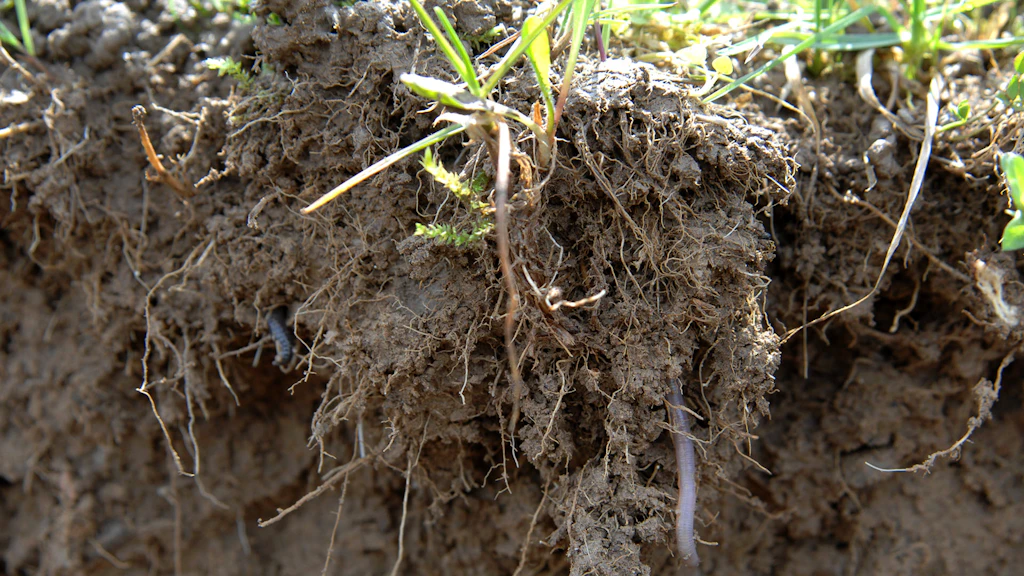
‘Humus’ is the term used to describe the more stable forms of dead organic matter in the soil stemming, among others, from plant roots, crop residues and organic fertilisers. Some components of the organic matter supplied to the soil are broken down in a matter of weeks or months by soil fauna and microorganisms, whilst others remain as humus in the soil over decades or centuries.
In order to ensure soil fertility, the decomposition and subsequent delivery of humus must stay more or less in equilibrium, i.e. the humus balance must remain steady. Organic matter is contributed e.g. by dead bits of plants (including crop residues) and organic fertilisers (e.g. dung, compost). As soil organic matter is broken down by soil organisms, the energy locked in the organic matter and the available nutrients are used. At the same time, the soil organic matter is mineralised, i.e. converted into simple inorganic components (ultimately into carbon dioxide, water, and inorganic substances that can be reused as plant nutrients). Intensive tillage (deep primary tillage and all-over fine seedbed preparation, the norm e.g. when growing crops such as potatoes) speeds up mineralisation, whilst the cultivation of multi-annual temporary leys slows it down. Within the SAEDN, the humus balance is calculated according to the method of Neyroud et al. (1997). You’ll find more information on the calculation below.
To determine humus decomposition, the desired minimum humus content must first be calculated. Using the mass of the tilled topsoil (in t/ha), this is first extrapolated to an amount of humus (in kg/ha), then multiplied by the net decomposition coefficient (dependent on clay content, soil pH and tillage intensity) in order to estimate humus loss (in kg/ha and year). For clay contents above 10%, the desired minimum humus content increases linearly with the soil’s clay content. Topsoil mass per ha is determined on the basis of topsoil thickness and bulk density. For purposes of simplification it is assumed that topsoil thickness is approx. 0.3m and topsoil bulk density is 1350kg/m3, leading to a soil mass of 4000t/ha. To calculate the decomposition coefficients, the following factors are taken into account:
Soil clay content: A higher clay content slows down humus decomposition, since the humus components are more strongly bound or enclosed by the clay particles (clay-humus complexes)
pH: Increasingly alkaline conditions (pH>7) slow down humus decomposition, since increasing numbers of calcium ions bind the humus components more strongly to the surface of the mineral soil particles or enclose said components, as well as reducing soil-microorganism activity.
Proportion of root crops (e.g. potatoes): A high proportion of root crops, i.e. intensive tillage, increases the availability of humus components to the soil organisms, thereby facilitating decomposition.
Proportion of temporary leys: A high proportion of temporary leys, i.e. no- or minimum tillage, decreases the availability of humus components to the soil organisms, thereby slowing down humus decomposition.
Both main crops and catch crops (roots and crop residues) as well as organic fertilisers are taken into account as input sources for humus-forming organic matter. The supplied quantity of humus-forming organic matter (in kg humus per ha and year) is given in the form of tabulated values for the different crops and fertilisers. These are default values, and therefore require no actual crop yield measurements or details on the exact organic-matter content of the fertilisers.
The humus balance is calculated by subtracting humus decomposition from humus-forming organic matter. To calculate the humus balance on farm level, all of a farm’s plots of land are aggregated. If the farm uses the same controlled rotation on all plots, this process provides an overview not only of the humus balance of the entire farm, but also of the prospective development over the course of a rotatio.
The humus balance of an entire farm is calculated as an area-weighted average. Negative values represent a loss of soil organic matter in the form of humus, indicating a long-term risk of soil fertility loss.