
Flavescence Dorée: Reducing Disease Pressure by Managing Hazel Bushes
A study conducted in Ticino by Agroscope and the Federal Research Institute for Forest, Snow and Landscape WSL shows that coppicing hazel bushes in the vicinity of vineyards can sustainably reduce populations of Orientus ishidae, an alternative vector of flavescence dorée.

The management of flavescence dorée (FD) is based on three pillars:
- insecticide treatments targeting the leafhopper Scaphoideus titanus, the main vector of the disease
- rogueing of the infected vines
- the use of hot-water-treated plant propagation material is recommended.
Despite these measures, this incurable disease continues to progress, suggesting that other vectors and host plants are contributing to its spread.
The O. ishidae leafhopper / common hazel duo
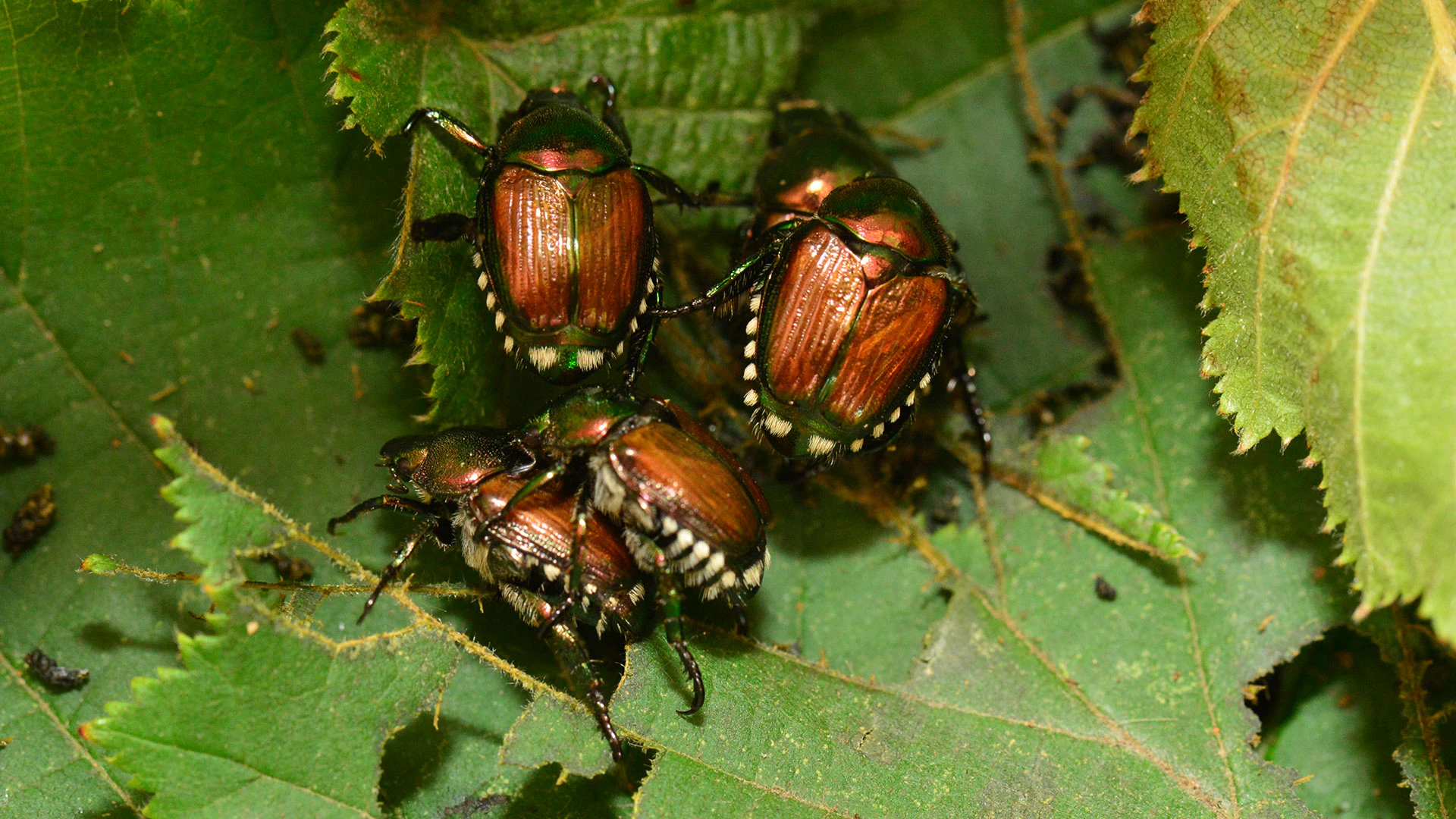
The researchers investigated Orientus ishidae, a leafhopper of Asian origin potentially capable of transmitting phytoplasmas associated with FD, as well as the common hazel (Corylus avellana), whose occurrence is widespread in forested zones bordering on vineyards. The study was conducted on eight winegrowing sites characterised by the close proximity of vineyards and forests, a typical configuration south of the Alps. The findings were published in the Journal of Economic Entomology.
Questions for a flavescence dorée expert
Below are three questions posed to Attilio Rizzoli, senior author of the study and scientific-technical associate at Agroscope’s Neobiota Competence Center.
Why are you concerned specifically with hazel bushes, and what have you observed?
Our experience has confirmed that the hazel bush is indeed a host plant for O. ishidae. We sampled several hazel branches to test oviposition. The large numbers of larvae hatched on these branches confirms that the adult females do indeed lay their eggs in the rough furrows of the hazelnut’s bark, and that this plant allows the complete development of the insect up to the adult stage. Furthermore, over the years it has been repeatedly reported that the vector and plant can both be infected by phytoplasmas associated with FD. These last findings also match observations made in other countries. Finally, the hazel bush is a very common species in our forests, so it seemed natural to us to study it as part of a broad and holistic FD management strategy.
What measures for reducing populations of O. ishidae have you tested, and with what results?
We have tested a simple habitat management measure: the coppicing of hazel bushes growing in the immediate vicinity of areas heavily colonised by O. ishidae. The results have been particularly encouraging: Already In the first year after coppicing, O. ishidae populations declined steeply at the treated sites. Three years later, reductions ranged between 75 and 82%, and as much as 86% at a site where all the above-ground biomass of the hazel bushes was removed as part of a chestnut orchard restoration project.
This decrease was also observed in neighbouring vineyards, where the number of insects trapped decreased by up to 87%. The effects remained unchanged despite the natural regrowth of the hazel bushes, suggesting that a single intervention can produce lasting benefits. By contrast, at the control sites (no coppicing), O. ishidae populations generally remained stable, or even increased.
So should all hazel bushes near vineyards be removed?
No, certainly not all hazel bushes, and this would be no substitute for the other existing compulsory measures.
The findings of this study essentially highlight the importance of the landscape in the epidemiological cycle of FD, showing that targeted management can help reduce disease pressure.
There are surely other species besides hazels that should be monitored as a matter of priority – alders, for example. Moreover, other woody species have also been identified as being infected with phytoplasmas associated with FD.
Before undertaking targeted silvicultural interventions, it is crucial to understand the forestry elements that could play a role in the epidemiology of FD. It is also important to evaluate the sustainability issues and to strike a balance between the costs and benefits for managing vineyards and the surrounding environment.
In general, the management of hazel bushes and the landscape in the wider sense could incorporate and supplement the control measures currently in force. Being relatively inexpensive, easy to implement and compatible with more-sustainable crop protection, this integrative strategy seems especially appropriate in vineyards bordered by forests, where it is justified by disease pressure.
Further information
Index
Centre de compétences Néobiotes
Le centre de compétences Néobiotes, à Cadenazzo (TI), élabore des méthodes de lutte pour prévenir et contenir la propagation de nouveaux agents pathogènes, ravageurs et plantes envahissantes. La pression de ces organismes exotiques indésirables est en constante augmentation et représente une menace potentielle pour l’agriculture suisse

WhatsApp channel for practitioners
Aimed at agricultural practitioners, the information is shared on our WhatsApp channels 'Agroscope_fr' (French) and 'Agroscope_de' (German).